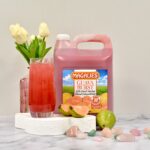
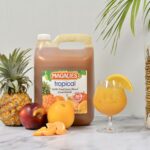
Somewhere in South Africa right now, someone is pouring a jug of juice for a school fun day, a church bazaar or a Sunday braai, and there is a good chance it started life as fruit juice concentrate. It is one of the most practical inventions in the food world: all the flavour of the fruit, a fraction of the space, and a bottle that turns into litres of juice with nothing more than cold water.
But what exactly is concentrate? How is it made, how do you mix it properly, and how does it compare with “fresh” or “not from concentrate” juice? This guide answers all of that, decodes the labels on South African juice bottles and gives you a handy calculator to plan your next party.
Fruit juice concentrate is real fruit juice with most of its water gently removed. It is stored and shipped in a small volume, then you add water to bring it back to drinking strength. A typical retail concentrate is mixed at 1 part concentrate to 4 to 7 parts water, so a 5-litre bottle makes 25 to 40 litres of juice.
What Is Fruit Juice Concentrate?
Fresh fruit juice is mostly water; orange juice, for example, is roughly 85 to 90% water. Making concentrate simply means taking a large share of that water out, leaving the sugars, acids, colour and flavour behind in a thick, syrupy liquid.
South Africa’s regulations on the classification of fruit juice and drink (R.286) define concentrated juice as natural fruit juice from which water has been removed so that it is at least double the standard strength of that juice. Internationally, the Codex Alimentarius sets the equivalent rules in its General Standard for Fruit Juices and Nectars (CXS 247-2005).
How Fruit Juice Concentrate Is Made, Step by Step
Every producer has its own recipe for quality, but the journey from orchard to concentrate typically follows these steps. You can see how Magalies does it on our manufacturing process page.
- Harvest and delivery: ripe fruit arrives from the orchards, often within hours of picking.
- Washing and sorting: the fruit is washed, and damaged or unripe fruit is removed.
- Extraction: juice is pressed or extracted. With citrus, the peel oil is often recovered separately at this stage.
- Screening and clarifying: pips, pulp and fibre are screened out. Some fruit cells may be kept for texture.
- Pasteurising: the juice is briefly heated to make it safe and stable (read more about pasteurisation).
- Evaporation: water is removed in an evaporator, usually under vacuum so it boils at a lower temperature and protects the flavour.
- Aroma recovery: volatile aromas captured during evaporation can be returned to the concentrate.
- Cooling and packing: the concentrate is cooled and packed into drums, bags or bottles for storage and sale.
At Magalies, this starts in our primary production facility, where citrus becomes raw-material concentrate, fruit cells and peel oil. Secondary production then blends and bottles the finished products.
Concentrate vs Not-From-Concentrate vs Fresh Juice
Walk down any juice aisle and you will see three big families of juice. Here is how they compare at a glance.
| Type | What it is | Storage and shelf life | Best for |
|---|---|---|---|
| Fruit juice concentrate | Juice with most of the water removed; you add water back | Long shelf life unopened; compact to store and transport | Families, schools, caterers, events, bottlers |
| Not-from-concentrate (NFC) | Juice that is pressed and pasteurised but never concentrated | Stored frozen or packed aseptically; shorter life once opened | Ready-to-drink cartons and premium juice |
| Fresh juice | Freshly squeezed juice with no additives | In South Africa it must be sold within two hours of extraction | Juice bars, breakfast at home |
None of these is “fake” juice. Juice made from 100% concentrate is simply fruit juice that travelled light and had its water added back at the end.
Juice Labels Decoded: 100% Juice, Nectar, Fruit Drink and More
South African juice products are grouped by how much real fruit juice they contain. The rules come from the regulations mentioned above, and our guide to fruit juice classifications explains every class in detail. Here are the ones you will see most often:
🍊 100% fruit juice
Made only from fruit juice, concentrates, pulps or purées. No added sugar or sweeteners are allowed.
🥭 Fruit nectar
Fruit juice, water and permitted sweeteners. The minimum juice content depends on the fruit: at least 50% for orange and apple, 20% for guava.
🍹 Fruit drink
Must contain at least 6% juice of the named fruit. Popular for big gatherings because it is affordable.
🧃 Squash and cordial
Syrupy concentrates you dilute at least 1:3. A squash contains at least 24% juice before dilution.
Want to go deeper into label reading? Our guides to reading the ingredient list and nutrition table and understanding use-by and best-before dates make it easy.
What Does “Brix” Mean on Juice and Concentrate?
If you work with juice, you will hear the word Brix (°Bx) a lot. Degrees Brix measure the sugar content of a liquid: 1 °Brix is roughly 1 gram of sugar in 100 grams of liquid. Producers use it to check ripeness, to control how far juice is concentrated and to make sure the reconstituted juice tastes the way it should.
For a sense of scale, ready-to-drink orange juice usually sits at around 11 to 12 °Brix, while orange juice concentrate is commonly concentrated to about 65 °Brix. That is why concentrate pours like syrup.
How to Mix Fruit Juice Concentrate Perfectly
The mix ratio on the label is your recipe. A ratio of 1:4 means 1 part concentrate to 4 parts water, which gives 5 parts of juice in total. Use any measure you like: a cup, a jug or a bucket for a big event.
- Shake the bottle well before opening.
- Pour the concentrate into a clean jug or container.
- Add cold, clean water according to the ratio on the label.
- Stir well, then taste. Chill or add ice before serving.
- Keep mixed juice covered in the fridge and enjoy it within a few days.
Juice Concentrate Calculator: How Much Will You Make?
Planning a function? Use this calculator to see how many litres and glasses a bottle makes, and how many bottles you need for your guest list.
🧮 Juice concentrate calculator
Pick a bottle size and mix ratio to see how much juice you will make.
Always follow the mix ratio printed on your bottle. Ratios differ by product and flavour.
Here is how the Magalies retail ranges compare. Each range page lists every flavour and its exact mix ratio.
| Magalies range | Bottle | Mix ratio | Makes up to |
|---|---|---|---|
| Fruit Nectar Concentrates | 1 litre | 1 : 4 | 5 litres |
| Fruit Nectar Concentrates | 2 litres | 1 : 4 | 10 litres |
| Fruit Nectar Concentrates | 5 litres | 1 : 4 | 25 litres |
| 6% and 12% Fruit Drink Concentrates | 5 litres | 1 : 4 | 25 litres |
| Fruit Burst Nectar Concentrates | 5 litres | 1 : 5 to 1 : 6 | 35 litres |
| 100% Fruit Juice Blend Concentrates | 5 litres | 1 : 4 to 1 : 7 | 40 litres |
5 Litre Juice: How to Get the Best Value per Glass
Comparing juice by bottle price can be misleading, because one bottle may make 25 litres and another 40. The fairest way to compare is the cost per glass:
Cost per glass = bottle price ÷ number of glasses
Number of glasses = bottle size in litres × (water parts + 1) × 4 (for 250 ml glasses). Example: a 5-litre bottle mixed at 1:4 makes 25 litres, or 100 glasses. If that bottle costs R200, each glass costs just R2.
Remember to compare like with like: a 100% juice blend and a 6% fruit drink are very different products. Choose 100% juice or nectar when fruit content matters most, and fruit drinks when you need to stretch a budget across a big crowd.
Is Juice From Concentrate Healthy?
Juice reconstituted from 100% fruit concentrate keeps the fruit’s natural sugars and minerals and much of its vitamin content, which is why it counts as real juice. Colour matters too: the pigments that make juice red, orange or purple come from plant compounds, as our article on the benefits of colour in fruit juice explains.
Like all juice, it should be enjoyed in sensible portions. The World Health Organization counts the sugars in fruit juice as free sugars and recommends limiting them. Read about the role of fruit juice in a balanced diet and how your body absorbs the nutrients in juice for the full picture.
- Choose 100% juice when you want the most fruit per glass.
- Serve juice with meals, in a normal-sized glass.
- Dilute a little extra for young children if they prefer a lighter taste.
- Use juice in smoothies with yoghurt and fruit for extra fibre.
How to Store Concentrate and Mixed Juice
- Unopened bottles: store in a cool, dry place out of direct sunlight, and check the best-before date.
- Opened concentrate: close the cap tightly and refrigerate, following the instructions on the label.
- Mixed juice: keep it covered in the fridge and use it within a few days.
- Hygiene: always use clean jugs and clean drinking water.
Buying Fruit Juice Concentrate in Bulk
Running a school tuck shop, a catering company, a restaurant or a bottling plant? Concentrate makes even more sense at scale. Juice is one of the categories where fruit juice product trends keep shifting, and a reliable supply of consistent concentrate is what keeps your product tasting the same, batch after batch.
- Households and events: 1, 2 and 5 litre bottles from our retail range.
- Wholesale and catering: 5-litre ranges supplied through our distribution centres around South Africa and neighbouring countries.
- Bottlers and manufacturers: 25 and 50 litre Blopacs, 200 litre steel drums and 1,000 litre Flexi-tainers in our bulk packaging range.
Quality matters at this level. Magalies is a proud member of SGF International, the fruit juice industry’s voluntary quality control organisation, and you can see our full list of certifications on our website.
Ready to pour? Find your favourite flavour in bottles from 1 to 5 litres, or talk to us about bulk supply.
Compare juice rangesBulk enquiriesLooking for ideas? Mix up a quick orange shandy for the weekend or blend The Kickstarter fruit juice smoothie for breakfast.
Frequently Asked Questions About Fruit Juice Concentrate
What is fruit juice concentrate?
Fruit juice concentrate is fruit juice from which most of the water has been removed, usually by gentle evaporation under vacuum. South African regulations define concentrated juice as at least double the standard strength of the juice. You add water back to drink it.
How do you mix juice concentrate?
Follow the ratio on the label. A 1:4 ratio means one part concentrate to four parts cold water, so one cup of concentrate makes five cups of juice. Stir well and keep the mixed juice in the fridge.
How much juice does 5 litres of concentrate make?
It depends on the mix ratio. At 1:4 a 5-litre bottle makes 25 litres, at 1:6 it makes 35 litres and at 1:7 it makes 40 litres of juice.
Is juice from concentrate as healthy as fresh juice?
Juice reconstituted from 100% concentrate keeps the fruit’s natural sugars and minerals and much of its vitamin content. Nectars and fruit drinks contain less fruit and usually added sugar. Whatever the type, enjoy juice in moderation as part of a balanced diet.
What is the difference between 100% juice, nectar and fruit drink?
In South Africa, 100% fruit juice may not contain added sweeteners. A nectar contains a set minimum of fruit juice that depends on the fruit (for example 50% for orange and 20% for guava). A fruit drink must contain at least 6% juice of the named fruit.
Where can I buy fruit juice concentrate in bulk in South Africa?
Magalies Citrus supplies retail bottles from 1 to 5 litres through its online shop and distribution centres, and bulk concentrate in 25 and 50 litre Blopacs, 200 litre drums and 1,000 litre Flexi-tainers for bottlers and manufacturers.
Fruit juice concentrate is one of those everyday products that quietly does a lot of work: less transport, less packaging and more juice for the money. Mix it right, store it well and enjoy it in sensible glasses, and a single bottle can keep a whole party refreshed.